


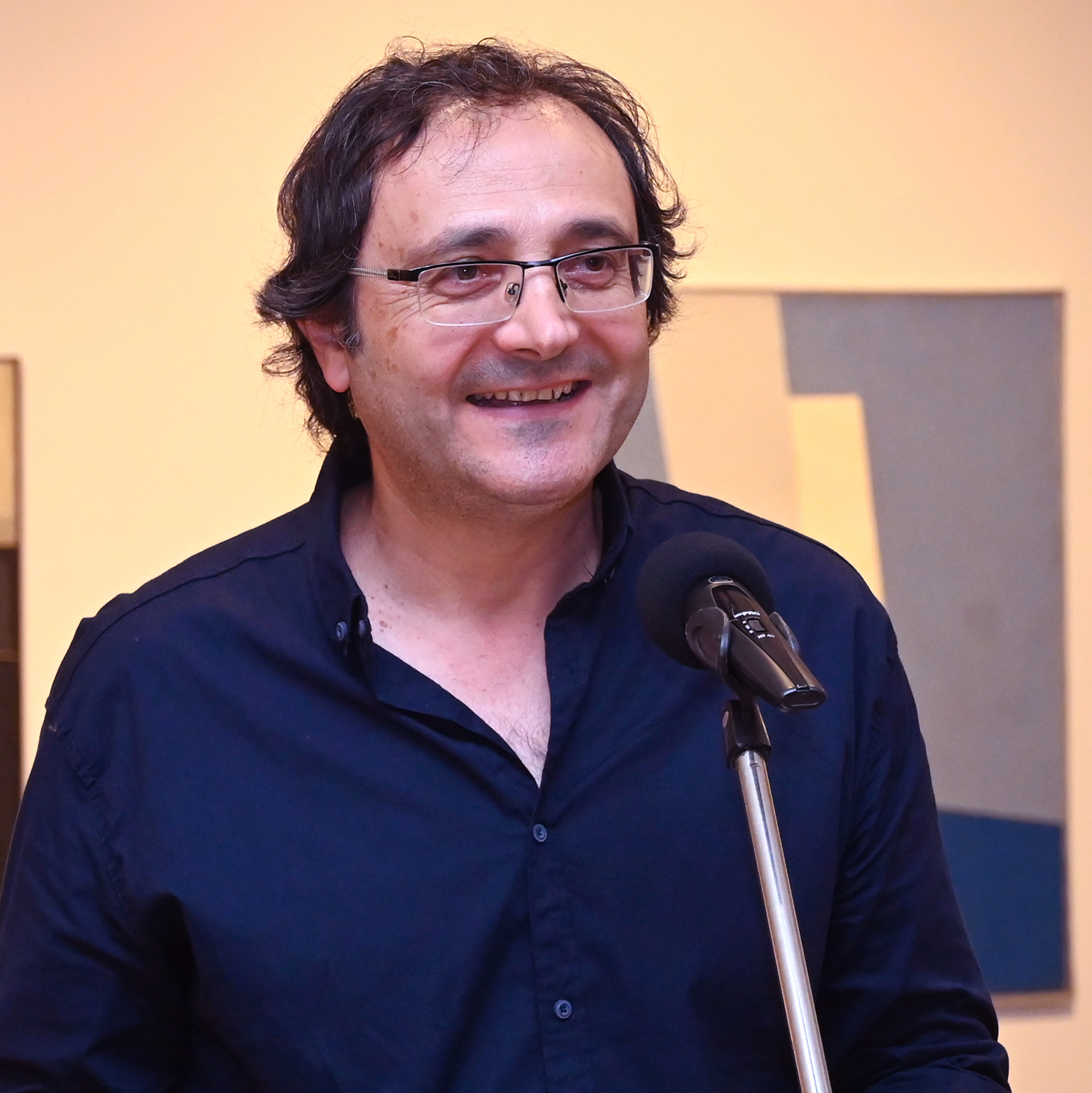
‘I truly think only the best of the Fund’s competition! And not because I won this year, but because it convinced me that there was true professionalism, objectivity and impartiality in Bulgaria—in this society worn out by all sorts of malaise. But as it happens, this was something real. Thank you for that!’
The 15th ‘13 Centuries of Bulgaria’ 2026 National Literary Prize for Bulgarian Novel of the Year was made possible with the financial support of the Ministry of Culture.
Boyan Yordanov’s novel, ‘Under the Moon, Huge as a Pumpkin’, published by Janet-45 Print and Publishing, won the ‘13 Centuries of Bulgaria’ 2026 National Literary Prize for Bulgarian Novel of the Year. It competed in the 2026 NEF ‘13 Centuries of Bulgaria’ competition for the first time along with 30 other novels, and was awarded by the jury.
Bisera Yosifova, Executive Director of NEF ‘13 Centuries of Bulgaria’, thanked the jury and presented the prize to its author Boyan Yordanov at the award ceremony held at the Sofia City Art Gallery. She expressed special gratitude to the Ministry of Culture, which, in connection with this year’s 45th anniversary of the Fund’s establishment, provided financial support for the ‘13 Centuries of Bulgaria’ 2026 National Literary Prize for Bulgarian Novel of the Year.
Boyan Yordanov answered questions specifically for Untold Stories:
- Who is Boyan Yordanov?
Born in Botevgrad in the long-gone year of 1971, as a small child, he used to write fairy tales; later in secondary school, he tried his hand at composing poems and plunking away on the guitar. Be that as it may, like any other serious person, he turned to studying serious science. He graduated as a chemical engineer and—as if that wasn’t enough—also defended his doctoral dissertation. He currently works in a pharmaceutical company, or more specifically, in the quality control of medicinal products. After a hiatus of decades, realising that he still had something to share with people, he returned to literature. His first book, ‘The Beloved’, was published by Janet-45, and three years later, the same company produced his second novel titled ‘Under the Moon, Huge as a Pumpkin’.
- What inspired you to write ‘Under the Moon, Huge as a Pumpkin’? Was there a specific reason?
This story is about a generation as if birthed to be sacrificed in the slaughterhouses of the twentieth century; in fact, this is the generation of my great-grandfather who died in the First World War at the age of 25. I simply had to tell about these people. They deserved it. You could say they took on our sins, for it is difficult for a person who went to war to remain pure. We now live in peace and this is a real blessing, although we do not always appreciate it. The story takes place in the Macedonian lands, because events there have been extremely dramatic. It is in such conditions that the Bulgarian national psychology manifests itself perfectly well—it is visible, just like actors are visible under the spotlight. But the historical events are only the context. Many other issues are treated in the novel—topics where history is used simply as a background.
- What does writing mean to you?
Creating worlds. This is so wonderful! At the same time, it is occasionally a very gruelling job. For everything you describe has to go through you. Besides, sometimes things get stuck and then one can lose sleep, and become unbearable for others. At such moments, it is difficult for someone unaware of the situation to understand. But I know it has to be hard for it to be beautiful. For me, there’s no other way.
- Is it difficult to be a writer in Bulgaria? What do you think—is he free?
Terrific question! On the one hand, anyone may write and publish anything; there are publishing houses where you pay yourself, even if you don’t have an editor. But so what? If you’ve written and published a book this way, does that make you a writer? However, regarding the writer you might be asking about—for him, to be free is vital. This is an essential condition. It is not the only one, but it’s indispensable. If his writing is conjunctural, if he behaves opportunistically, he might achieve some success, but I really doubt it’s worth it. I’m sure that a good writer must always be in opposition, and that’s not easy at all. One cannot write well without resistance. But, in fact, this also applies to any other human activity.
- What does the past mean to you?
Everything is past. The past is in my genes. The light of the universe that we see is past. I myself am a past since yesterday—should I renounce my beliefs? On another level, it is very interesting, and yet on another, if we see the good examples in it, then the present imposes a deep obligation upon us. From this perspective, I think we are greatly indebted to some people who have lived before us—such great debtors that we should sink into the ground with shame.
- Over 50 novels have been published in Bulgaria in recent years. What do you think about Bulgarian readers? Is their attitude towards books changing?
In my immediate circle, there are people who read and people who don’t read at all. Some devour everything, some can’t even manage a single line. I could hardly answer this question since I don’t have enough information. One has to track the trend over time, and I can’t. Indeed, what I see is that most people do not read. There are fewer readers. But, that’s how it is in life: some people are thinkers, they decide things for others, or at least they make decisions for themselves, while the rest are simply obeyers. That’s normal. That’s the way it’s always been and always will be.
- Are you optimistic about the future?
My answer is this: yes, I am optimistic because every person and every people deserve their own future. For there is a higher justice, which is immutable and unavoidable. So, everything is fine! I am sanguine.
- This is your first time participating in the ‘13 Centuries of Bulgaria’ What do you think about it?
I truly think only the best of the competition! And not because I won this year, but because it convinced me that there was true professionalism, objectivity and impartiality in Bulgaria—in this society worn out by all sorts of malaise. But as it happens, this was something real. Thank you for that!
- After this prize, what lies ahead?
Hopefully, an even better literature.
Questions posed by Theodora Bankovska
14 May 2026
Translated by Nigrita Davies