


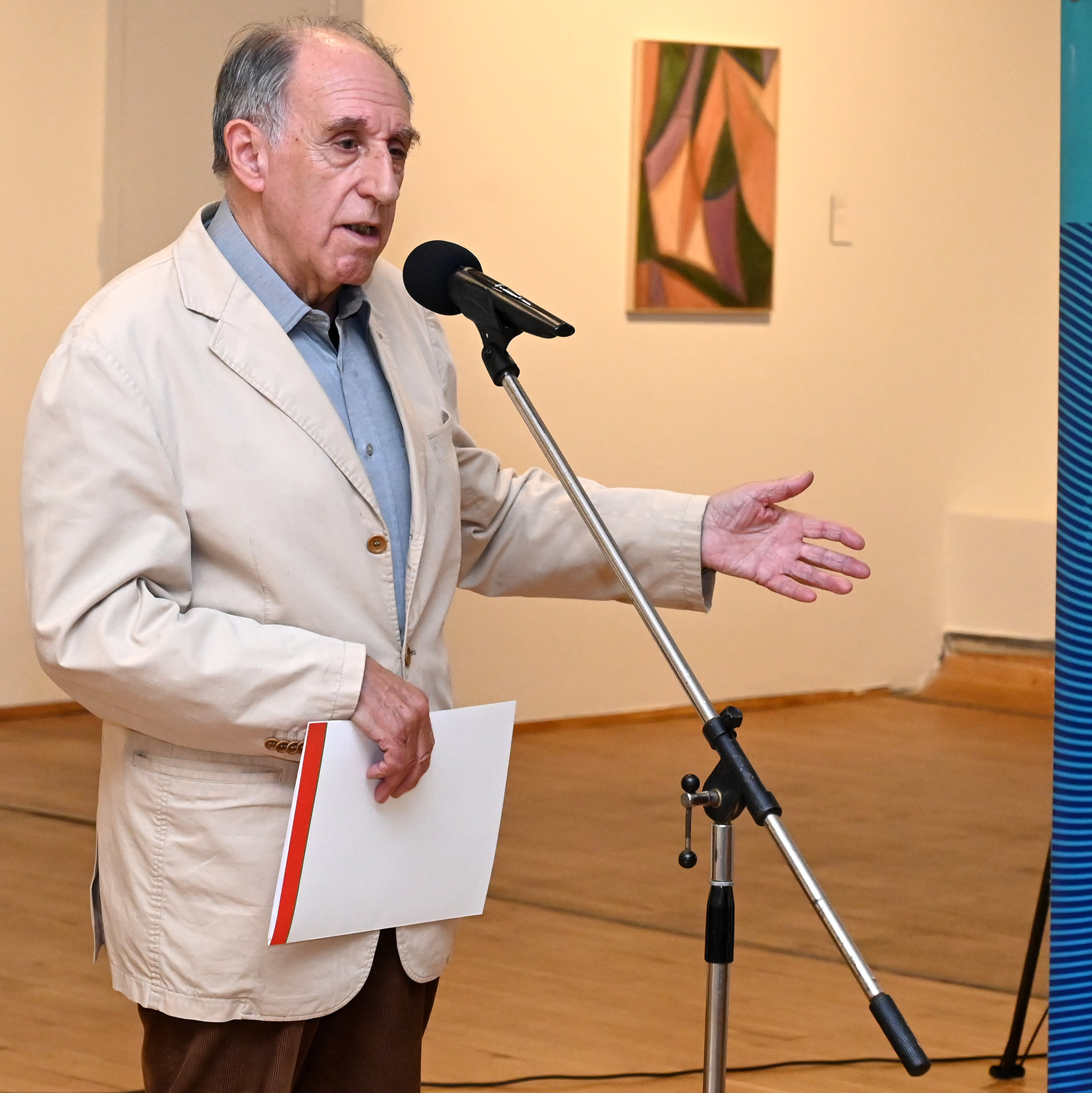
Prof. Bozhidar Manov is an acknowledged researcher of cinema, long-time lecturer at the National Academy for Theatre and Film Arts, film critic and journalist. He is a recipient of the Golden Age Prize of the Ministry of Culture, and an honorary citizen of Sofia.
This year, he was elected Chair of the Jury for the ‘13 Centuries of Bulgaria’ 2026 National Literary Prize for Bulgarian Novel of the Year.
Prof. Bozhidar Manov answered questions specifically for Untold Stories:
- As Chair of the Jury for the ‘13 Centuries of Bulgaria’ 2026 National Literary Prize for Bulgarian Novel of the Year, would you please tell us whether it was easy to pick out the nominated novels and the winning novel?
There was no unanimity while deciding on the nominations of the six novels, and then the selection of the winner. We therefore made use of the option under Art. 19 of the Statute and took a decision by simple majority. So, it was not easy, but we did it through reasonable professional discussions and arguments, without too much tension.
- What is your opinion: how is Bulgarian literature and, more specifically, the Bulgarian novel developing?
In general, it is developing normally—no major surprises or unexpected discoveries (in terms of themes, subjects, or style). While at the same time, there are some individual beacons of achievement that have found recognition internationally. Two of Georgi Gospodinov’s novels, ‘Time Shelter and ‘Death and the Gardener’, as well as ‘She Who Remains’, by Rene Karabash, became all the rage for European media and literary forums.
- Are the topics that Bulgarian authors write about changing?
Yes, they are changing, but not considerably. The unrestrained ‘squaring accounts’ with the totalitarian years has prompted the appearance of some important, good, and necessary books. But the complex, overly long, and quite vacillating ‘transition’ has not yet produced the truly powerful novels! The new economic situation and the complex social shifts associated with it have not yet crystallised the adequate literary reflection, which should be absolutely honest for readers to believe in it! The vogue generation, GenZ, is still a journalistic cliché, and does not produce truly exciting literature! And the members of that generation are different from the teen cuties who are also completely absent from our literature. GenZ will soon replace them! But this is not an easy process, and therefore there are still empty literary terrains.
- What do you think of the young generation of authors? Will there be writers whose works will be translated?
I distinguish between the seemingly equivalent categories of ‘writers’ and ‘authors’! As a charming aphorism states, ‘Many writers, few authors’! I do not expect any sort of ‘Bulgarian wave’ in foreign-language territories. We don’t have such an export potential. The world is changing before our very eyes, and we have a hard time catching up with it in our own country. Besides, good literature should not be imitative. And before we flood the world with novel, original ideas, we must first catch up with the ones we have missed out.
- In what way does world literature influence the works of Bulgarian authors?
I think we have no weighty arguments to talk about such influence from contemporary world literature. We encounter it partly; it is not homogeneous or clearly defined in certain examples. Perhaps it would be more productive and useful if our authors succeeded in the reverse process: to develop and offer their books to be included in the catalogue of contemporary world literature. I think that should be much more interesting and reputable.
- What do you think of artificial intelligence? Can it replace the living creator?
The world is very actively, and sincerely excited about a future with artificial intelligence. Good science fiction writers have even already described it partially. But to the question: ‘Can it replace the living creator? The answer is obvious: it can replace both the living and the dead craftsman. But not the creator!
- Every year, NEF ‘13 Centuries of Bulgaria’ makes donations of books to libraries and community centres. In 2026, the Fund’s anniversary year, we started a large-scale campaign of donating books to prestigious Bulgarian universities, many of which at their request. What are your observations? Has the attitude of Bulgarians towards books changed?
As far as I understand, ‘we started’ means ‘we launched’! And this is a good and useful initiative! I am afraid, however, that the attitude of the Bulgarian towards books (generally speaking) has changed under the influence of overly aggressive entertainment shows and series on television. But the segment of ‘devoted readers’ still exists! To them is our responsibility!
Prof. Bozhidar Manov, DSc (Art History)
Born on 12 December 1947 in Sofia
A film critic and journalist, doyen Professor at the National Academy of Film and Television Arts. Dean of the Faculty of Screen Arts (2011–13). At present, lecturet at the New Bulgarian University. Member of the National Cinema Council (2004–10; 2018–20). Member of the Board of Directors of the National Culture Fund (2005–09; 2019–21). Vice-President of FIPRESCI (2001–05). Member of the European Film Academy. Repeatedly a member and chairman of international juries at film festivals including Berlin, Cannes, Venice, Karlovy Vary, Busan, Thessaloniki, Istanbul, Dubai, San Sebastian, Palm Springs, Gothenburg, and Cairo. Numerous participations in international conferences, scientific symposia and congresses. Author of articles in Bulgarian and foreign publications. Honorary citizen of Sofia.
Authorial books: ‘Theory of the Cinematic Image’ (1996), ‘Digital Audiovision’ (2000), ‘The Digital Element’ (2003), ‘Unimaginable Man’ (2004), ‘Festival Meetings’ (2007), ‘Cinema and Other Temptations’ (2008), ‘Evolution of the Screen Image’ (2004, 2012), ‘Festival Meetings 2’ (2020), ‘People with Nicknames’ (2023), ‘What is it? Riddles in Verse’ (2025).
Translated books (from Macedonian): ‘Conversation with Spinoza’, Goce Smilevski (2010); ‘Sigmund Freud’s Sister’, Goce Smilevski (2013); ‘A Spare Life’, Lidija Dimkovska (2015); ‘The Return of the Words’, Goce Smilevski (2015); ‘Non-Oui’, Lidija Dimkovska (2018); ‘Infidelity’, Dejan Trajkoski (2020); ‘Personal Identification Number’, Lidija Dimkovska (2026).
Questions posed by Theodora Bankovska
12 May 2026
Translated by Nigrita Davies