


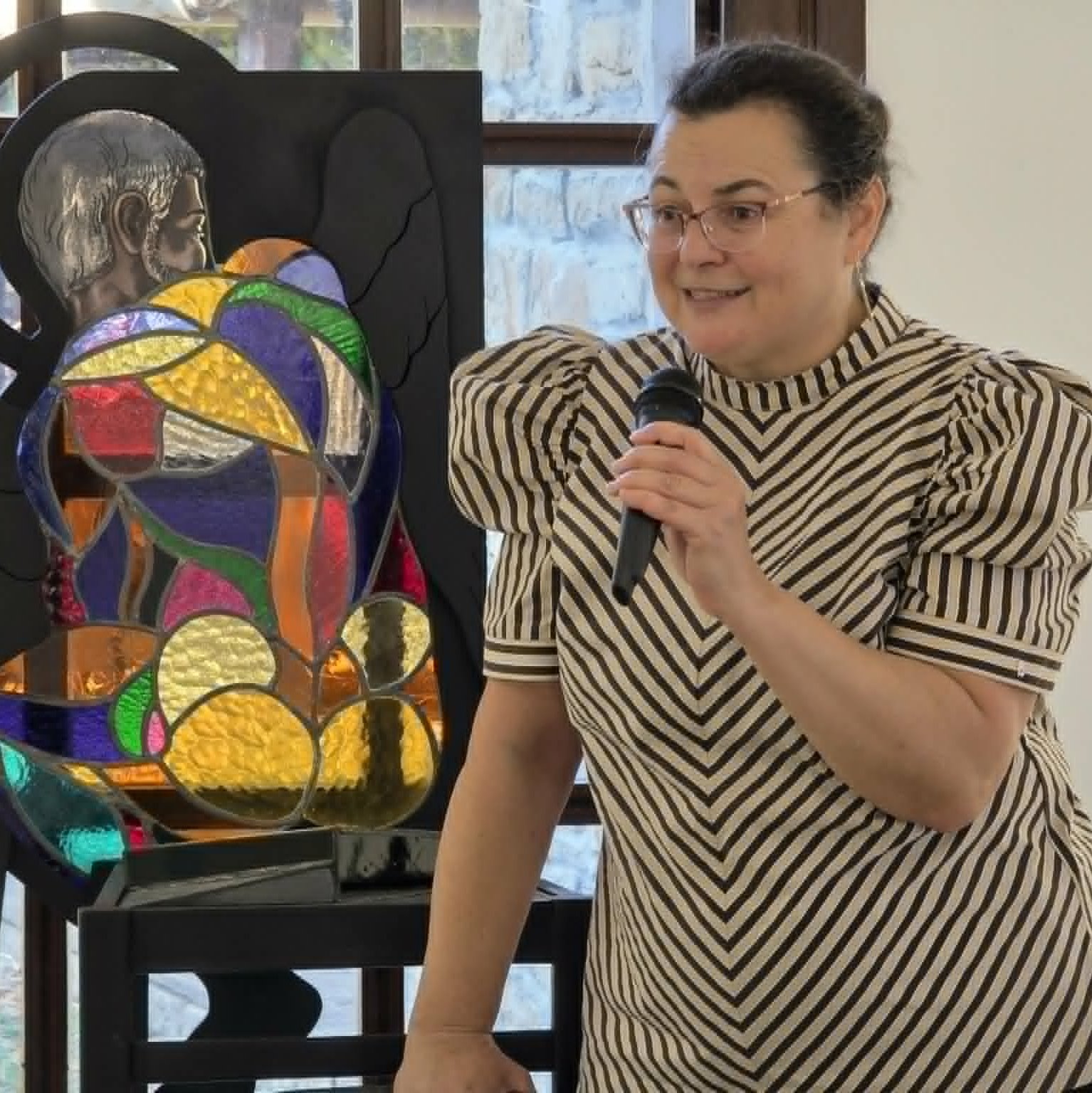
The public lecture held on 1 September 2026 at the Gabenski Gallery, the regional centre of NEF ‘13 Centuries of Bulgaria’ in Tryavna, was the first official event of the Pavone d’Oro Foundation. It was a joint initiative of NEF ‘13 Centuries of Bulgaria’ Gabenski Gallery and the Foundation itself. Pavone d’Oro is dedicated to promoting a deeper understanding of Asia’s cultures, arts, and societies, through creating and disseminating various educational resources.
‘Ornament and Sacrality’ was prepared in May for this year’s European Night of Museums, and has since been delivered in Sofia and at the Regional Museum of History in Haskovo.
The research draws a comparison between two seemingly distant traditions: painting on Ficus leaves in the Indian state of Kerala and the Bulgarian Revivalist custom of painting on dried ivy leaves in Tryavna. In both cases, the artistic creation is a symbol-laden plant, whose historical roots trace back to ancient religious and cultural beliefs. In India, the sacred tree serves as an archetype of the Cosmic Tree, symbolising the connection between heaven, earth, and the spiritual realm, while ivy has been recognised since Thracian times as a symbol of vitality, longevity, and sacral power. Both traditions demonstrate how a natural element transforms into a bearer of memory, identity, and spiritual significance.
Stela Stoilova, Director of the Foundation, explains that the lecture ‘analyses the origins of these two art forms—distinct in nature yet sharing a common aspiration to preserve and express cultural values. In India, leaf painting stems from reverence for the sacred tree and the tradition of using its leaves as a medium for drawing and artistic practices. In Tryavna, the tradition of painting on ivy leaves emerged as a creative response to the social and fashion-related trends of the 19th century, gradually evolving into a local symbol. A comparison is made between the execution techniques, which involve the specialised preparation of the natural leaf base and its transformation into an artistic composition through painting and decorative detailing. Characteristic motifs are examined: Indian works predominantly feature deities, spiritual scenes, mandalas, and mythological themes, whereas the Tryavna painted ivy is primarily associated with floral ornamentation and the local community’s festal culture. The lecture demonstrates how both traditions live on today through contemporary interpretations, serving simultaneously as artistic heritage, cultural symbols, and a bridge for dialogue between the past and the present.’
‘Ornament and Sacrality’ was the first lecture of a series by the Pavone d’Oro Foundation dedicated to various crafts; the series traces their origins, techniques, and characteristic motifs and symbols, as well as the pathways of cultural exchange that have facilitated the spread of decorative textile practices from Asia to Europe.
The foundation was registered in 2026. Zlatko Paunov, donor to NEF ‘13 Centuries of Bulgaria’ and an honorary citizen of Tryavna, was one of its founders.